Abstract
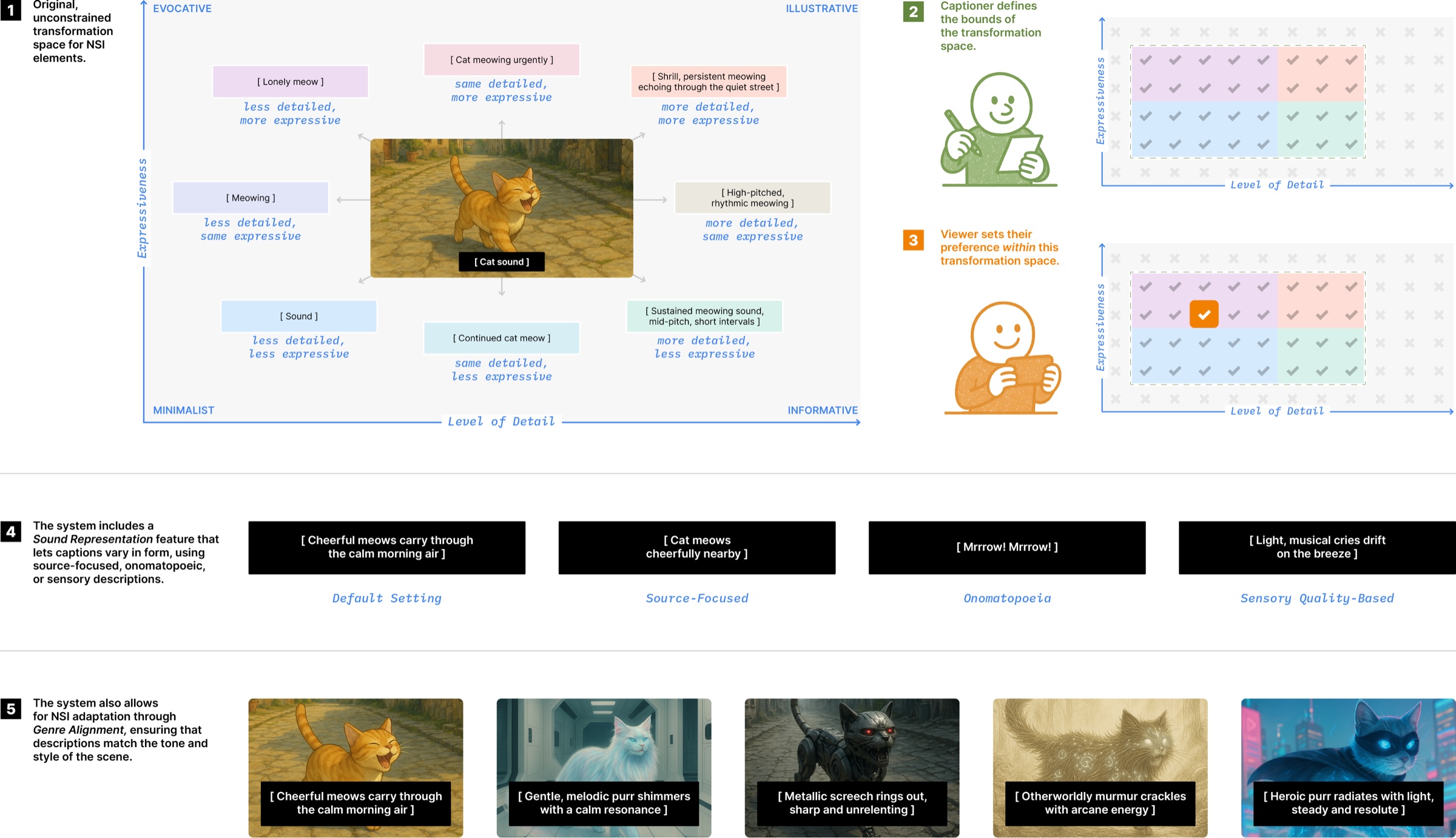
Non-speech captions are essential to the video experience of deaf and hard of hearing (DHH) viewers, yet conventional approaches often overlook the diversity of their preferences. We present CapTune, a system that enables customization of non-speech captions based on DHH viewers’ needs while preserving creator intent. CapTune allows caption authors to define safe transformation spaces using concrete examples and empowers viewers to personalize captions across four dimensions: level of detail, expressiveness, sound representation method, and genre alignment. Evaluations with seven caption creators and twelve DHH participants showed that CapTune supported creators’ creative control while enhancing viewers’ emotional engagement with content. Our findings also reveal trade-offs between information richness and cognitive load, tensions between interpretive and descriptive representations of sound, and the context-dependent nature of caption preferences.
System Architecture
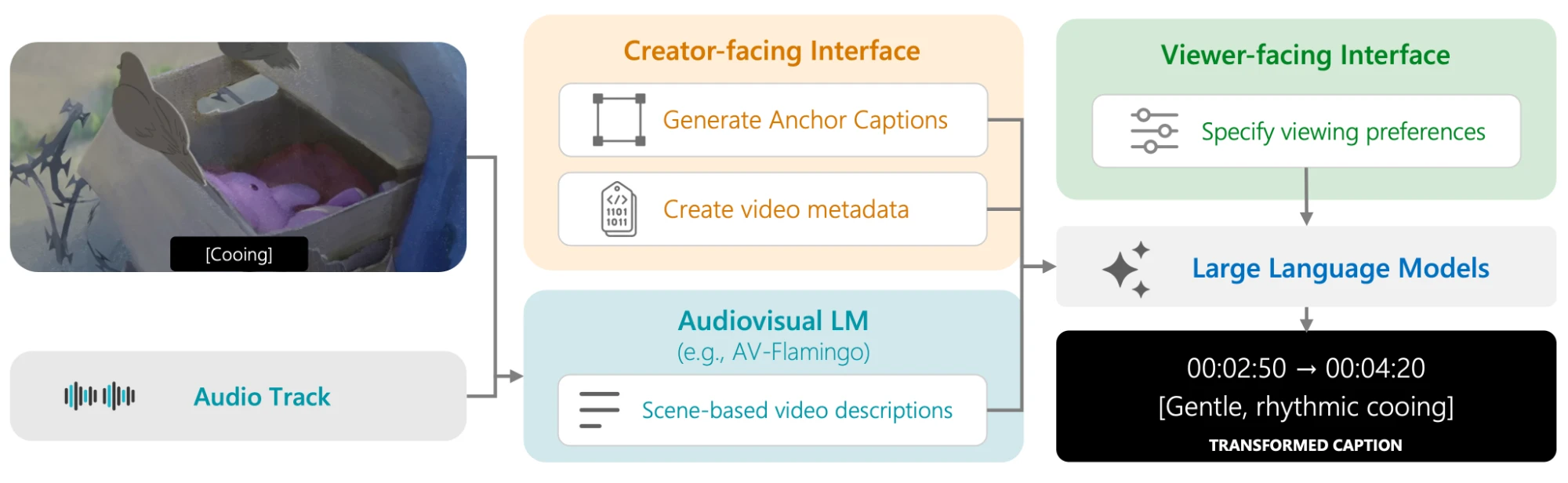
CapTune is organized as a pipeline from creator specification to viewer-specific caption generation. Given a video and its caption file, the system first isolates the non-speech captions and extracts audiovisual context for each one: an audiovisual language model processes the surrounding video segment and its audio track to produce a scene-based description. In the creator-facing interface, a large language model estimates where each original caption lies along two dimensions, level of detail and expressiveness, and the creator generates a lower and an upper anchor caption that bound the range of acceptable transformations. These anchors, the scene descriptions, and the video metadata are packaged with the original captions. In the viewer-facing interface, viewers specify their preferences through direct manipulation or natural language, including their desired position within the creator-defined range, a sound representation method, and genre alignment. At transformation time, the system expresses each request relative to the anchors, quantifying how far the target lies between the lower and upper anchor captions and how much it departs from the current caption, and passes these ratios to the language model together with the anchor captions and scene context. The model therefore interpolates between concrete, creator-approved references rather than generating captions from scratch, keeping every transformation within the creator’s intent.
BibTeX
@inproceedings{huang2025captune,
  title     = {CapTune: Adapting Non-Speech Captions With Anchored Generative Models},
  author    = {Huang, Jeremy Zhengqi and de Lacerda Pataca, Calu{\~a} and Wu, Liang-Yuan and Jain, Dhruv},
  booktitle = {Proceedings of the 27th International ACM SIGACCESS Conference on Computers and Accessibility},
  series    = {ASSETS '25},
  year      = {2025},
  numpages  = {18},
  location  = {Denver, CO, USA},
  publisher = {Association for Computing Machinery},
  address   = {New York, NY, USA},
  doi       = {10.1145/3663547.3746346},
  url       = {https://doi.org/10.1145/3663547.3746346}
}